The Audi Max
abril 13, 2023 English / Interviews and Reviews / Interviews and Reviews / Latest news and Upcoming events
Conference at: “Network for an Alternative Quest” invites people to the conference “Challenging Capitalist Modernity IV: We want our world back — Resist, Reclaim and Rebuild” in Hamburg.
Here.
Now.
We.
In the Audi Max.
Of the University of Hamburg.
Here, now, we are turning education around. We, here, now are saying that our education, our learning, our teaching is part of the struggle of life against money. Not part of the rule of money over life, as universities usually are. We are going in the opposite direction. That is what these three days are about.
That is what I had written before I heard of the shameful, despicable, contemptible decision by the President of the University, Dr. Hauke Heekeren, acting on the advice of the Verfassungsschutz last week to exclude us from the AudiMax and other university buildings. I had already decided to change the title of my talk to “In the AudiMax”.
I was excited about the idea of the AudiMax, partly because I had the experience of speaking there in the conference of eight years ago, but also because I grew up with a romantic idea of German universities. I spent time at the Universities in Tübingen, Frankfurt and Cologne, I was in love with Ernst Bloch, Theodor Adorno, Herbert Marcuse, and I was strongly influenced by friends like Joachim Hirsch, Elmar Altvater, Christel Neusüss, Heide Gerstenberger and many others. I had the idea of German universities as spaces of rigorous, critical thought, or at least spaces in which rigorous critical thought can be developed.
And now this! I feel the stupidity of this decision almost as a personal affront that shatters my romantic illusions. How can an institution that bans three days of critical discussion call itself a university? This ridiculous decision ruins the reputation of the University of Hamburg and, by contagion, damages that of the German University system. Shame on you, Dr. Heekeren! You have betrayed the richness of your own tradition.
So now my talk begins in a slightly different way:
Here.
Now.
We.
Expelled from the Audi Max.
Expelled from the University of Hamburg.
Here, now, we are turning education around. Here, now,we shout out to all the world: We want our world back! Resist, Reclaim and Rebuild. Do Autonomous Education and Organize.And here, now, we say clearly: Fuck off, Dr. Heekeren! Fuck off, administrative council of the University of Hamburg! Fuck off, Verfassungschutz. We do not need you, we are doing it by ourselves.
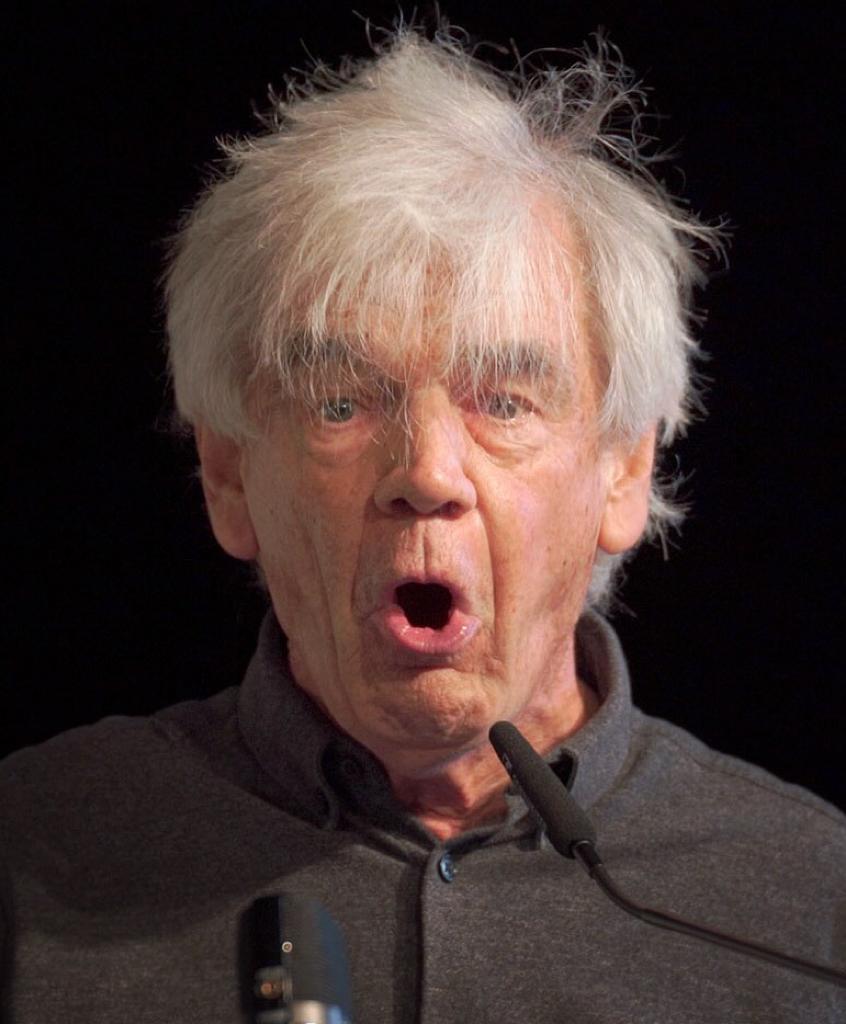
Photo by: Hinrich Schultze – www.dokumentarfoto.de
But there is more than that. Yes, we have left the university and come here to do autonomous education, and the shameful decision by the university underlines the importance of this. But we have to do more. Many of us who are here, as teachers, as students, as parents or whatever, are not entirely outside the universities or schools. We do not just want to walk away, we want to understand the universities and schools as places of struggle. We want our universities and our schools back. My friend Lars Stubbe has told me something about the struggles here in the University of Hamburg and how the slogan generated here, “Unter den Talaren – Muff von 1000 Jahren” (“under the academic robes, the mould of a thousand years”) became a central slogan of the student movement of the late sixties. Within the universities, there is a struggle all the time about how decisions are taken, but also, and crucially, about what we talk about and how we talk about it. It is not always a spectacular struggle, but it is one that all of us that are in the universities and schools are involved in in every single class, every seminar, every thesis, every time we write, every time we speak.
This is a struggle not just between different groups of people. It is much more important, much more urgent; it is the struggle between life and money. The University administration of Hamburg has now openly declared that it is on the side of money against life, and that is increasingly the tendency for universities and schools throughout the world, even if they do not declare it so brutally as the University here has done. But for us, the struggle is for life against money.
Life against Money was the slogan of the wonderfully mad, wonderfully mind-breaking Zapatista trip to Europe in 2021. The argument is simple. We live in a world ruled by money. The rule of money is the rule of capital, the rule of profit. They are inseparable. We have known for a long time that this causes enormous social suffering. Money shapes our access to the riches of the world. The so-called food crisis mentioned in various of the talks on Friday (in other words the hunger, malnutrition, starvation now being felt not only in the poor countries of the world, but also here in Hamburg, here in Europe) is not the result of a shortage of food but simply the result of the fact that our access to food is mediated through money. Thousands and thousands of people die each day, by starvation, curable illness or violence, for no other reason than that money shapes the way that we relate to one another. The way in which we act each day, and the way we think about our lives, is shaped by the fact that money stands as gatekeeper to survival and to enjoyment. It is money that channels us into labour, into dedicating our lives to an activity that we do not control, an activity that, directly or indirectly, is shaped by the need to generate the expansion of money, to generate profit. It is money that creates poverty and extreme wealth. It is money that shapes the way we think, the categories we use. It is money and its insatiable need for expansion, for profit, that is destroying the world.
That is what is new, or at least new in its urgency. We have long seen how the rule of money causes suffering, but it is only in the last twenty or thirty years that it has become clear how the rule of money, the rule of capital, is a terrible dynamic of destruction that is threatening humanity with extinction and already causing the massive extinction of other forms of life. Money means ecocide, means multicide. Through global climate change, through the destruction of biodiversity and the consequent generation of pandemics, through the exhaustion of the water supply, the rule of money is pushing us deeper and deeper into catastrophe.
The growing awareness of this dynamic of destruction has led to the emergence of new lines of social struggle, less focussed perhaps on the suffering caused by money, more on the threat to our future existence, as in the movement for climate justice. The danger is that sometimes the connection is lost, that it is not seen that the struggle against exploitation and the struggle against global warming are both struggles against the rule of money.
Can these problems be solved within the context of a world ruled by money? Possibly, but it seems unlikely. The dramatic statement, Life against Money, Money against Life, is probably not an exaggeration. If we maintain the rule of money, the rule of profit, then it is very likely that we are heading towards the extinction of the human species.
We have, then, only one scientific question left. How can we stop the rule of money from destroying human life completely? That is the one question that must inform our thinking about education at all stages: how do we stop the destructive dynamic that is money, that is capital? A scientific question, an educational question, a political question.
A question, not an answer. We do not have the answers. Preguntando caminamos, Asking we walk, as the Zapatistas put it. That is important because it takes us into a different understanding of education and of politics. If we have the answers, we must explain them to the masses, to those that do not know. A politics of answers is a politics of monologue. But if we do not have the answers, then we must enter into a dialogue, into a conversation in which we say “this is what I think, what do you think?”. A sharing of ideas, of doubts, of experiences, of confusions. An experimenting, an overflowing, a pushing beyond, with uncertain steps.
A politics of asking leads to forms of organisation that are anti-vertical, to assemblies, councils, communes, and not to the state. It takes us away from the idea of taking power, because the power, our power-to, is already in the process of collective doing.
The rule of money seeks to contain both acting and thinking, to channel it within certain guidelines that are conducive to the production of profit and to the production of a social order that respects the rule of money. An education from the perspective of money imposes definitions, limits. Often those limits are not obvious: we can say or do whatever we want, as long as we respect the rule of money and the order necessary to support it. The University of Hamburg reminds of those limits with brutal stupidity, but they are present all the time.
Education for life against money, on the other hand, cannot be an imposition of definitions, limits, identities. It starts simply by saying “No”, “No, there is something wrong here, we cannot accept that any more, ¡ya basta! Enough!” The ¡ya basta! is the breaking of a barrier, an identity. At first we may feel that we are on our own. And then we look around and see that we are not alone, that there is a whole history of struggle, a whole world of struggle, in many different shapes and sizes, with shining lights like Rojava and the zapatistas, like Lützerath or the uprising in France in the last few weeks, or the paro in Colombia two years ago, or the revolt in Chile in 2019, or indeed the great student strike in the UNAM in Mexico City twenty years ago that effectively stopped the introduction of fees in the public universities of Mexico. And of course sometimes the No is much less spectacular, people trying to shape their lives in a way that goes against the rule of money. Or perhaps just the student who stands up in the classroom and says “shouldn’t we be thinking about our subject in a different way, in a way that subverts the rule of money over life?” Often the struggles are defeated, or seem to be, but the struggles of the past live on, demanding that we should pick them up, that we should redeem them, make them ours.
In talking of education for life against money, it is important, then, to hear of the wonderful experiments in Rojava or Chiapas and many, many more. The brutality of the university makes it clearer than ever that we must think of autonomous education, of doing our own thing, and that is precisely what we are doing this weekend. But we must also remember that we (or at least most of us) still have a foot trapped in the shit of the old world. We live not only beyond but also in-and-against the old world and we must fight from there. Here. Now. We. In every school, every university, every class, every time we talk, every time we write.
Life against Money. Madness, madness, madness. Are we not mad to fight for life against the rule of money, when it seems impossible that we can ever win? There are two answers.
The first is that perhaps we are mad, but then perhaps this madness is the meaning of human life. This is dignity. It is the need to fight against what is wrong.
And the second answer is that perhaps we are not mad. We want more than dignity. We want to win. Money is a channelling, a series of forms that channel or seek to channel our lives into subjection, into certain patterns that promote the accumulation of capital: if you do not behave in a certain way, you will die of starvation or at least live in misery. But there is always at least a latent and sometimes explosive resistance to that channelling. There is always an underlying rebellion that threatens to overflow. The forms of capitalist domination are always under strain.
What makes this more difficult for capital is that it cannot stand still. In order to reproduce itself, it must keep on tightening its control over our behaviour, it must constantly intensify the exploitation of labour and, to do this, it must constantly tighten its subordination of all aspects of human and non-human life. This is not easy to achieve. There is always a fear at the centre of domination that we should never underestimate, a fear that it might lose control, that we might overflow its channels. Always that fear is hidden and it may be that capital is pushed into a pretence, a fictitious existence, in order to secure at least the appearance of its own reproduction. The surest sign that that is happening is the way in which money itself is under strain, as evidenced by the huge expansion of debt over the last forty years and the resulting financial instability.
And now the University of Hamburg has shown that it too is under strain. It is an institutional form that seeks to contain thinking and discussion within a certain framework. In this case it has shown that it is unable to do so. The violence of its reaction is a declaration of its own weakness, its fear of what we might say. Not only is it contemptible: it is laughable, ridiculous.
Finally I would like to say a word of thanks to the Verfassungsschutz for labelling us as “extremists”. Yes, of course we are extremists. We are extremely opposed to the rule of money, to the capitalist system that is destroying the world and pushing us in the direction of extinction. And we are extremely committed to thinking and discussing and practising ways forward towards a better world, a world beyond capitalism. And we are extremely opposed to your attempts to limit what we can say and think. We will not be contained. If fighting for the fountain of life against the cistern of money is extremism, then we are extremists and proud of it.
John Holloway.