Reflection on the Conference in Istanbul
diciembre 10, 2025 English / Latest news and Upcoming events
John Holloway – 6 and 7 December
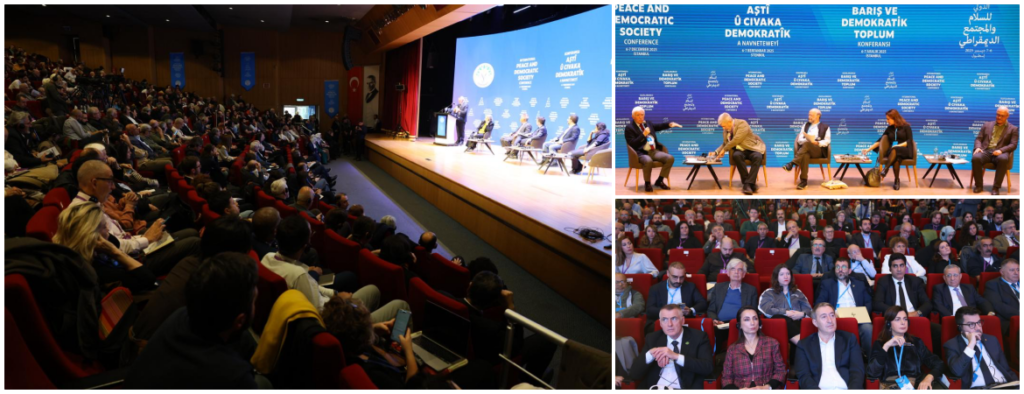
The title of the conference on 6 and 7 December was On Peace and Democratic Society. It was organised by the DEM Party, the Kurdish Party in Turkey that supports Abdullah Öcalan and the current peace process.
The first day of the conference I found disappointing, but I also learnt a lot. The central theme was peace and the practicalities of achieving it, in the context of the present negotiations between the Kurdish movement and the Turkish state. The conference took the form of a series of speakers in front of an audience of about 500, with no time for discussion. Many of the speakers were politicians, from Turkey and elsewhere. There were speakers from Catalunya, the Basque country, Ireland and South Africa, on how peace has been achieved in situations where it seemed impossible. All the discussion was focused on the reform of the state. Two things stood out for me: the emphasis on the importance of leadership and (in the case of South Africa) the need to temper people’s expectations. With the exception of an excellent letter from Öcalan, entitled “Let´s Reclaim Socialism Through Peace and The Building of a Democratic Society” (read by Veysi Aktaş, who was released in July after spending 10 years in Imrali Prison), there was little mention of social change, much less communising.
In my talk on the second day, I wanted to do two things. I wanted to explain my enthusiasm for the Kurdish Freedom Movement, but also to explain my disappointment with the first day. I had no idea what sort of reaction I would get, but I felt that that reaction would influence my relation to the movement. As it turned out, the reaction was overwhelmingly positive. This came first in the intervention by Hayder Erqol, the editor of the movement’s journal, Democratic Modernity (in Turkish) almost immediately after mine, but was confirmed by the reaction afterwards of many of the conference participants and the reactions I received in the following two days in Diyarbakir from people who had been following the streamed version of the conference, and finally from Öcalan himself who, I am told, followed the proceedings and sent through his lawyers the message that “from the conference, your intervention in particular stood as an important theoretical and practical addition to the ongoing process”. This reaction is immensely encouraging and fires my enthusiasm for the movement.
My conclusion is that there are really two things going on, both important in different ways, and with a complex and contradictory relation between them.
The first is a movement for the creation of a multinational state (reminiscent perhaps of what Evo Morales achieved in Bolivia). This would recognise the specific identity and legal status of the Kurdish people and promote their language and their culture. After years of violent repression of the Kurds and their culture, this would mean a real and important peace. It would include the release of Öcalan and the many other political prisoners being held in Turkish jails. After meeting a number of people who had been in prison for thirty years and more and seen places in Diyarbakir where war was being fought less than ten years ago, it is impossible not to support this longing for peace. It is in this context that I understand the interest in the participation in the conference of politicians from other countries where oppressed minorities have achieved legal recognition.
This movement for the legal recognition of the Kurds can be seen either as the principal aim of the movement – I suspect that this is the position of many DEM politicians and many members of the movement – or it can be seen as the first stage of a process that would open up space for much more radical change: this was the argument that Öcalan’s lawyers explained to me. The danger of the complex negotiations with the Turkish state is that legal recognition becomes in practice the sole aim of the movement.
The other element of the Kurdish movement, the one reflected in the positive reactions to my talk, is something much more profound and inspiring. This is the determination to bring about a total transformation of society and create a communising society, a society organised not in states but on a communal basis, based on what Öcalan calls “democratic confederalism”. This was not the dominant theme in the conference but is obviously an important part of the history of the struggle.
The distinction between the two faces of the movement can be connected with Öcalan’s critique of the “nation state”. This can be interpreted in two ways: either as “we don’t want a nation state, we need a multinational state” (the first approach), or as “we don’t want a state at all, we want a society organised on a communal basis” (the second approach).
There is no need to see the two approaches as antagonistic. I see them rather in terms of an overflowing which can be blocked. The “We are Kurds, but more than that, we are fighting for humanity” can easily become simply “We are Kurds fighting for legal recognition as such”. The same issue has been present in the Zapatista movement since the beginning: the “We are indigenous, but more than that, we are fighting for humanity” has always coexisted with an understanding of the movement as “We are indigenous, fighting for the recognition of indigenous rights and culture”. Both the Zapatistas and Öcalan have been very clear in pushing beyond this restrictive, identitarian interpretation, but the possible closure always stands as a danger.
In this context I think it is very important to push the anti-identitarian, communising perspective in all ways possible. The conferences and seminars planned for 2026 on “The Commune against the State” acquire a special importance.